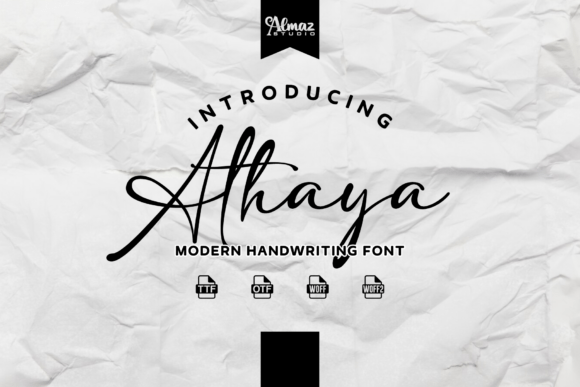
Athaya: Integrating Script Typography into Professional Design Workflows
Understanding the Functional Role of Script Typography
In the landscape of digital design and content creation, typography is not merely a decorative choice but a functional component of communication strategy. Among the various typographic categories, script and handwriting fonts serve a specific purpose. Athaya represents this category, characterized by its fluid strokes and mimicry of natural cursive or calligraphic writing. Unlike geometric sans-serifs or rigid serifs, script typefaces introduce a human element to digital layouts. They are designed to bridge the gap between cold, mechanical text and the organic warmth of personal correspondence.
For designers and business owners, understanding the mechanics of a font like Athaya is essential before implementation. It is classified as a display or decorative font, meaning it is optimized for visual impact at larger sizes rather than legibility in long-form body copy. Its structure often involves connecting ligatures and variable stroke weights that simulate the pressure of a pen on paper. This characteristic dictates how it functions within a layout: it draws the eye and sets an emotional tone, signaling elegance, creativity, or intimacy. Recognizing these inherent properties allows professionals to deploy the asset where it adds value rather than creating friction for the end-user.
Strategic Application in Branding and Identity
The integration of a script font like Athaya into a branding workflow requires careful planning. In the context of brand identity, typography acts as the voice of the brand. When a business selects Athaya for its logo or primary wordmark, it is making a decision to project attributes such as sophistication, artisanal quality, or personal care. This is particularly relevant for industries such as wedding planning, boutique hospitality, high-end retail, and wellness services.
During the design execution phase, Athaya should be treated as a focal point. A common implementation error is the overuse of script fonts, which can lead to visual clutter and a loss of legibility. The practical approach involves using Athaya for specific elements—such as the brand name, a tagline, or a call-to-action button—while pairing it with a clean, neutral typeface for supporting text. This hierarchy ensures that the decorative qualities of the font enhance the message without overwhelming the viewer. For example, a bakery might use Athaya for its window signage to evoke a homemade feel, but rely on a standard sans-serif for its menu descriptions to ensure customers can quickly scan prices and ingredients.
Workflow Integration: From Concept to Final Output
Integrating Athaya into a production workflow involves technical considerations that impact efficiency and final output quality. The process begins in the asset management phase. Before a project starts, designers must verify the font’s licensing model—whether it is available for commercial use, web embedding, or print distribution—to avoid legal complications later in the workflow.
Once the font is cleared for use, the implementation phase varies depending on the medium. In print design, such as creating invitations or packaging, the primary concern is kerning and tracking. Script fonts often require manual adjustment of the spacing between letters to ensure the connecting strokes look natural rather than strained. In digital environments, such as website headers or social media graphics, file format and loading speed become factors. Converting the font to modern web formats (WOFF2) and subsetting—removing unused characters to reduce file size—optimizes performance without sacrificing the visual integrity of the design.
Compatibility with Other Assets
Athaya rarely exists in a vacuum. Its utility is defined by its relationship with other design assets. When planning a layout, consider the texture of the background images or illustrations. Because script fonts have high visual texture, they pair best with clean backgrounds or minimalist imagery. If the background is busy, the legibility of the script decreases.
Furthermore, the color contrast must be managed carefully. Thin strokes, common in handwriting fonts, can disappear against high-contrast or complex color palettes. A practical tip for implementation is to test the font in grayscale first to ensure the structural integrity of the letters holds up before applying brand colors. This quality control step prevents revisions later in the process and ensures the design remains accessible to users with varying visual abilities.
Content Creation and Digital Marketing
For content creators, marketers, and bloggers, Athaya offers a way to break the monotony of standard web typography. However, its application in content marketing requires a process-oriented mindset. It should not be used for the body text of articles or emails, as this impedes reading speed and comprehension, particularly on mobile devices. Instead, it should be reserved for "stop-scroll" moments.
In a social media workflow, for instance, Athaya can be used to highlight a specific quote, a discount code, or a headline within a graphic. This creates a visual hierarchy that guides the follower’s attention to the most valuable information. When creating email campaigns, using a script font for the preheader or a personalized greeting can increase engagement by mimicking the look of a handwritten note, thereby increasing the perceived value of the communication. The key is to use the font to punctuate the message, not to carry the entire weight of the content.
Technical Execution and Quality Control
The difference between an amateur and professional implementation of a font like Athaya often lies in the details of execution. One of the most common issues with script fonts is the connection between letters. In many digital typefaces, the connections can look mechanical or break awkwardly depending on the letter combination.
To mitigate this, designers should utilize OpenType features if the software supports them. These features allow for the automatic swapping of standard letters for stylistic alternates or swashes, which improves the flow of the text. If the software does not support these advanced features, manual vector editing may be necessary to smooth out the curves and ensure the typography looks seamless. This attention to detail is part of the quality control phase, ensuring that the final asset—whether a printed business card or a digital banner—meets professional standards.
Long-Term Usability and File Organization
As projects accumulate, font libraries can become unmanageable. Proper organization of assets like Athaya is crucial for long-term workflow efficiency. Creating a standardized naming convention and folder structure for fonts helps teams locate assets quickly. Additionally, maintaining a "style guide" that documents the specific use cases for Athaya—such as "Use only for H1 headings" or "Minimum size 24pt"—ensures consistency across different team members and future projects.
By treating Athaya not just as a file to be installed but as a strategic tool to be managed, professionals can leverage its aesthetic qualities to enhance their work while maintaining a streamlined, efficient production process. This disciplined approach ensures that the font serves the project's goals, adding personality and clarity to the final design.